The Complete Guide to Paint Correction. What It Is, When You Need It, and What to Expect
April 22, 2026 · Joel Bryan
TL;DR: Paint correction is the process of machine-polishing swirl marks, scratches, and oxidation out of your clear coat. Single-step correction handles lighter defects, while two-step correction tackles deeper damage. It must be done before ceramic coating to avoid locking in imperfections.
If you have ever looked at your car in direct sunlight and noticed a spiderweb of fine scratches across the paint, you have seen what the detailing industry calls swirl marks. They are one of the most common paint defects on daily-driven vehicles, and they are almost always caused by improper washing.
Paint correction is the process of removing those defects from the clear coat to restore the paint to a smooth, reflective finish. It is not a quick fix or a cover-up. It is a permanent removal of surface-level damage that transforms how your vehicle looks.
At Bryan Car Care in Post Falls, paint correction is a core part of everything we do. It is included in both of our Protection Plans, and we offer it as a standalone service through our Paint Enhancement. Here is a complete breakdown of what paint correction involves, when you need it, and what to expect from the process.
What Causes Paint Defects in the First Place?
Most people assume their paint gets damaged from driving. And while rock chips and road debris are real, the majority of swirl marks and light scratches come from how the vehicle is washed.
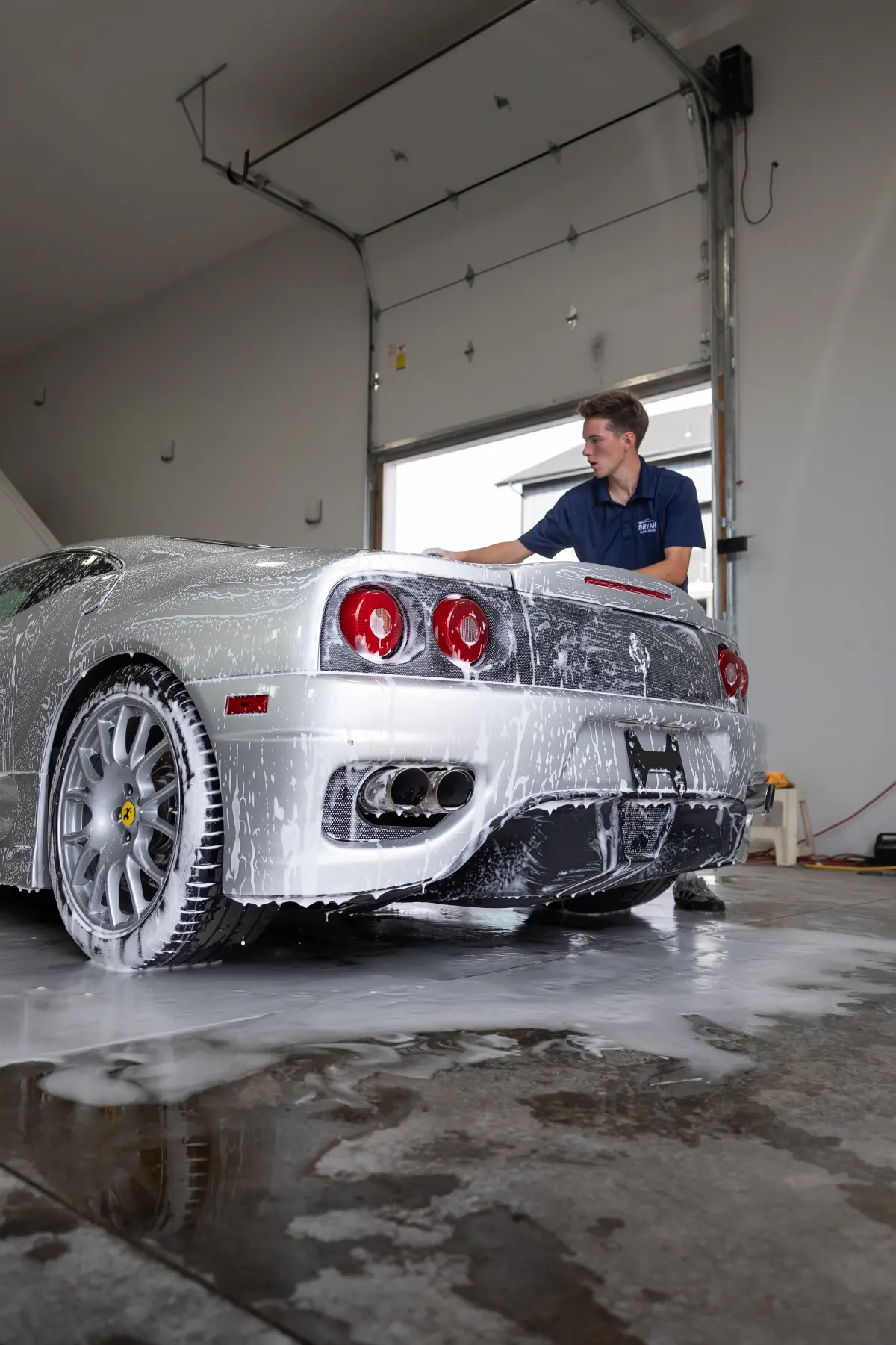
Automatic car washes are the biggest offender. Those spinning brushes drag dirt and debris across your paint thousands of times. Every pass through an automatic wash adds a fresh layer of micro-scratches to the clear coat. After a year or two of regular automatic washes, the damage is visible to the naked eye.
Improper hand washing is the second most common cause. Using a single bucket, dirty towels, or the wrong technique pushes grit across the paint and creates the same type of swirl marks. Even well-intentioned hand washing can cause defects if the process is not done correctly.
UV exposure degrades the clear coat over time, making it softer and more susceptible to damage. In North Idaho, where we get intense summer sun at altitude, UV damage accumulates faster than most people realize. Oxidized paint is dull, chalky, and far more prone to scratching.
Environmental contamination like bird droppings, tree sap, and hard water spots can etch into the clear coat if left on the surface too long. These etching marks leave permanent impressions in the paint that can only be removed through correction.
What Is Single-Step Paint Correction?
Single-step correction uses one combination of pad and compound to remove lighter defects from the paint surface. The compound is abrasive enough to cut through minor swirl marks, light scratches, and mild oxidation, but it also finishes clean enough that no additional polishing step is needed.
This is the right approach for vehicles with lighter defects. Daily drivers that are a few years old with minor wash marks and some light UV damage are usually good candidates for single-step correction.
The result is a significant improvement in clarity and gloss. Most of the visible defects are removed, and the paint looks dramatically better than it did before. Single-step correction typically removes 60 to 80 percent of surface-level defects depending on the paint type and condition.
What Is Two-Step Paint Correction?
Two-step correction is more aggressive and more thorough. It uses a cutting compound and a heavy pad in the first step to remove deeper defects, followed by a finishing polish and softer pad in the second step to refine the surface and maximize gloss.
This is the approach we use for vehicles with heavier swirl marks, deeper scratches, significant oxidation, or paint that has been neglected for years. The first step does the heavy lifting by removing the damaged material. The second step refines the finish to a mirror-like clarity.
Two-step correction can remove 85 to 95 percent or more of surface-level defects. The results are dramatic, and it is often the step that makes people say their car looks better than the day they bought it.
Our Lifetime Ceramic Coating includes full multi-stage paint correction as standard because we will not put ceramic coating over imperfect paint.
Why Controlled Shop Lighting Matters
Here is something most people do not think about. You cannot see paint defects accurately in a driveway, a parking lot, or under a cloudy sky. The lighting is too diffused and too inconsistent to reveal what is actually happening on the surface.
Professional paint correction requires controlled lighting. At our shop, we use LED inspection lights that replicate direct sunlight from every angle. These lights reveal every swirl mark, scratch, haze spot, and imperfection in the clear coat.
This matters for two reasons. First, you cannot correct what you cannot see. A detailer working in a driveway with no inspection lighting will miss defects that are clearly visible under controlled light. Second, you need that same lighting to verify your work. After each panel is corrected, we inspect it under the same lights to confirm the defects are fully removed before moving on.
This is one of the main reasons mobile detailing services cannot deliver the same level of paint correction as a fixed shop. The lighting, the controlled environment, and the equipment all live in our facility for a reason.
Paint Depth Readings and Test Spots
Before we start any paint correction job, we take paint depth readings across the entire vehicle using an electronic paint gauge. This tool measures the thickness of the paint in microns and tells us how much clear coat we have to work with on each panel.
This is a critical safety step. Paint correction works by removing a very thin layer of clear coat to eliminate the defects in the surface. If a panel has thin paint from a previous respray or previous correction work, we need to know that before we start. Going too aggressive on thin paint can burn through the clear coat, which creates a much bigger problem.
We also perform test spots on a small section of each paint type on the vehicle. This tells us which compound and pad combination will deliver the best results on that specific paint. Different manufacturers use different paint systems, and what works perfectly on a Toyota may not be the right approach for a BMW or a Ford. Test spots eliminate guesswork and ensure we get the process right before committing to the full vehicle.
What About the 30-Day Upgrade Credit?
Our Paint Enhancement starts at $695 and includes professional single-step or two-step paint correction with roughly 24-hour turnaround. It is a standalone service that delivers a dramatic improvement in your paint's appearance.
But here is the part that makes it an especially smart move. Every Paint Enhancement comes with a 30-day credit toward either of our Protection Plans. If you have the correction done and decide within 30 days that you want to add ceramic coating, the amount you paid for the Paint Enhancement gets applied toward the Protection Plan price.
This means you can see our work firsthand, evaluate the results on your own vehicle, and make the Protection Plan decision from a place of experience rather than guesswork. There is no pressure, no upsell during the appointment, and no expiration games. Just a straightforward credit that makes the upgrade easier if you decide it is right for you.
When Does Your Vehicle Need Paint Correction?
The simplest test is the sunlight test. Park your vehicle in direct sunlight and look at the paint at a low angle. If you see a web of fine scratches, haze, or dullness in the clear coat, your paint has defects that correction can remove.
Most vehicles over two years old with regular use will benefit from at least a single-step correction. Vehicles that have been through automatic car washes regularly, have never been professionally detailed, or have been parked outdoors in the North Idaho sun will almost certainly need two-step correction.
If you are considering ceramic coating, paint correction is not optional. Applying ceramic coating over defective paint locks those defects in and makes them permanent. Every Protection Plan at Bryan Car Care includes paint correction for exactly this reason.
What Should You Expect from the Process?
When you bring your vehicle in for a Paint Enhancement or Protection Plan, here is what happens. We start with a full wash and decontamination to remove all surface contaminants. Then we take paint depth readings and perform test spots. The actual correction work is done panel by panel under inspection lights, and each panel is verified before we move on.
For a standalone Paint Enhancement, the typical turnaround is about 24 hours. For a full Protection Plan with ceramic coating, the vehicle stays in our shop for 72 hours.
Every job includes before-and-after video documentation so you can see the transformation for yourself. We back everything with our 100% satisfaction guarantee. Visit our paint correction services page for pricing and details.
Frequently Asked Questions
How much does paint correction cost?
Our Paint Enhancement starts at $695 and includes professional single-step or two-step paint correction with roughly 24-hour turnaround. The final price depends on vehicle size and paint condition. Every Paint Enhancement also comes with a 30-day credit toward a full Protection Plan.
Does paint correction damage clear coat?
When done properly with paint depth readings and test spots, no. Professional paint correction removes a microscopic layer of clear coat to level out scratches and defects. We measure the clear coat thickness on every panel before starting to ensure safe correction. Going too aggressive on thin paint is a risk, which is why paint depth readings are a critical safety step.
How long does paint correction last?
The correction itself is permanent because the defects are physically removed, not filled or masked. However, the paint will develop new swirl marks over time if exposed to improper washing techniques. Ceramic coating over corrected paint helps maintain the results for years by adding a harder, more scratch-resistant surface layer.
Call us at (208) 215-7667 or request a quote to get started.
Joel Bryan
Owner, Bryan Car Care